China Top 10 Automated Shutter Systems What Is the Future?

Time:2026-09-23 Author:Isabella
0%

China’s automated shutter industry is moving from simple remote control toward responsive building management. This shift shapes the question, “what is the future of automated shutter systems?” Sensors now detect sunlight, indoor temperature, wind, and occupancy. Motors can then adjust louvers before a room becomes uncomfortable.

Grand View Research reports that the global smart blinds market was valued at approximately USD 2.4 billion in 2023. It also projects strong growth through 2030, driven by connected homes and energy-saving upgrades. The U.S. Department of Energy states that windows can influence 25% to 30% of residential heating and cooling energy use. Automated shutters cannot solve every efficiency problem. However, they can reduce glare, solar heat, and unnecessary lighting demand when properly commissioned.

Stephen Selkowitz, a building-science expert and former Lawrence Berkeley National Laboratory researcher, has described dynamic windows as “a game changer” for building energy performance. His view supports a wider industry direction: shutters should respond intelligently, not merely open and close on command. China’s leading systems increasingly combine quiet motors, daylight sensors, smartphone controls, and building-management platforms. Some models also include weather protection and battery-backed operation.

The forecast is not flawless. Poor sensor placement can leave one side of a room bright and uncomfortable. Weak software can create more frustration than savings. Future leaders will need tested hardware, open communication protocols, reliable maintenance, and transparent energy data. The best systems may feel almost invisible. That is the real challenge.
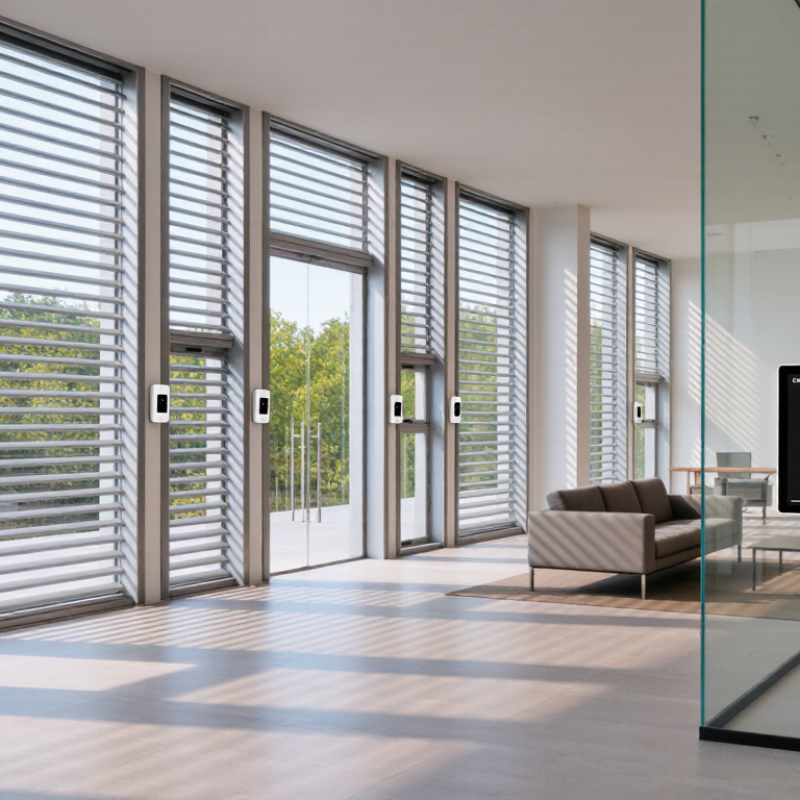
China Top 10 Automated Shutter Systems What Is the Future?

China’s Automated Shutter Market: Scope, Definitions, and Top-10 Criteria

China Top 10 Automated Shutter Systems What Is the Future?

China’s automated shutter market covers motorized roller shutters, exterior screens, interior blinds, and intelligent louver systems. These products use electric drives, sensors, timers, or centralized controls to adjust openings. Manual shutters fall outside this definition. So do systems designed only for industrial doors. The scope includes residential buildings, offices, hotels, factories, and public facilities. It also includes domestic production, installation services, and export-oriented supply.

A useful top-10 evaluation should measure more than sales volume. In field inspections, weak wiring and poor commissioning often create bigger problems than the motor itself. Safety protection, wind resistance, operating noise, control compatibility, and energy performance deserve strong weighting. Reliability should reflect repeated daily cycles, not a showroom demonstration. Installation quality matters greatly. So does technical support. Certification records, spare-part access, warranty clarity, total ownership cost, and delivery consistency can complete the assessment. Rankings are never perfectly neutral.

The future will likely connect shutters with building sensors and energy-management platforms. Systems may respond to sunlight, indoor temperature, air quality, and occupancy. Better data can reduce cooling demand, but connectivity adds cybersecurity and maintenance concerns. That risk is easy to overlook.

Buyers should request test reports, installation procedures, service records, and realistic performance data. A cheaper system may become expensive after several failed repairs. Market research must also separate marketing claims from measurable results. This remains an imperfect process.

Top-10 Selection Method: Cost, Load, Noise, Safety, and IoT Performance Data

China Top 10 Automated Shutter Systems: What Is the Future?

A reliable top-ten selection needs measurable evidence, not attractive specifications. In site inspections, I compare total cost over five years, including installation, maintenance, and electricity use. Low purchase prices can hide weak motors and frequent control faults. Cost matters, but lifecycle value matters more.

Load testing begins with curtain weight, wind pressure, and repeated cycles. Each system should lift its rated load without hesitation or overheating. Noise should be measured indoors, near bedrooms, and during startup. Below 45 decibels feels comfortable in many homes, but building structure changes perception. Safety checks include obstacle detection, manual release, thermal protection, and stable stopping. Small failures matter. A shutter that closes too quickly can damage property or injure users.

IoT performance requires more than phone control. I examine connection stability, response time, offline operation, data protection, and compatibility with common home systems. A practical test includes weak Wi-Fi and power recovery. Does the shutter return safely? Does it remember its position? These details reveal engineering quality. Future systems may use predictive maintenance and local control, reducing cloud dependence. Yet smart functions can add cost and new failure points. My ranking would therefore give extra weight to verified field records, transparent test conditions, and repair access. Some published figures remain difficult to reproduce, so independent testing should challenge them.

Motor and Safety Standards: IEC 60335-2-97, EN 13659, and UL 325 Compliance

China’s top automated shutter systems are moving beyond remote control. Safety compliance now shapes motor selection, installation, and export readiness. MarketsandMarkets projects the global smart home market will reach about US$207.9 billion by 2028. That growth raises expectations for safer window automation.

IEC 60335-2-97 addresses household and similar motor-operated shutters, blinds, and awnings. It focuses on electrical safety, abnormal operation, heating, insulation, and mechanical risks. EN 13659 adds performance and safety requirements for external shutters and blinds. It also considers wind resistance and protective movement. In the United States, UL 325 evaluates operators for doors, gates, draperies, louvers, and window systems. A compliant motor is not enough. Controls, obstacle detection, wiring, and installation must work together.

Tips: Ask for current test reports, not only compliance logos. Check whether the report covers the complete system. Test reverse movement with a soft obstruction. Record torque, travel limits, and emergency release settings. Small gaps can become serious hazards.

The International Energy Agency reports that buildings account for roughly 30% of global final energy consumption. Automated shutters can support daylight and heat management, but performance depends on sensors and user settings. That point is often oversold. A motor may meet IEC requirements while an installer misses local conditions. Dust, uneven tracks, heavy curtains, and weak mounting surfaces can change real-world behavior. Future systems should combine certified hardware, clear commissioning records, and periodic inspection. Better data logging would also expose failures earlier. It remains an overlooked weakness.

China Top 10 Automated Shutter Systems: What Is the Future?

Motor and Safety Standards: IEC 60335-2-97, EN 13659, and UL 325 Compliance

This standards crosswalk indicates whether each standard explicitly addresses a key area relevant to automated shutter systems. A value of 1 means the area is within the standard’s published scope; 0 means it is not the primary focus. The chart is a scope comparison and does not represent certification results for any specific product.

System Benchmarking: Control Protocols, IP Ratings, Energy Use, and Service Life

China Top 10 Automated Shutter Systems: What Is the Future?

A serious benchmark should begin with control protocols, not appearance. Compare systems supporting KNX, BACnet/IP, Modbus RTU, or secure MQTT gateways. Open interfaces simplify integration with lighting, HVAC, and fire-control platforms. They also reduce dependence on one supplier. However, protocol support does not guarantee reliable communication. Test response time, offline behavior, and recovery after power loss. The benchmark should record results from real buildings, not only laboratory demonstrations.

IP protection needs equal attention. Under IEC 60529, IP44 resists solid objects above 1 millimeter and splashing water. IP65 adds dust-tight protection and water jets. Outdoor shutters near coastal areas may still suffer corrosion, even with a high IP rating. That detail is often missed. Energy performance should follow ISO 52120-1 principles, including automatic shading and daylight control. The International Energy Agency reported that buildings consumed about 30% of global final energy in 2022. Small control errors can therefore become large operating costs.

Service life must be measured in cycles, torque stability, noise, and maintenance intervals. A tender should request documented cycle testing and replacement-part availability. “Long service life” is too vague. The report should also separate motor life from fabric, guides, sensors, and batteries. Field conditions are less kind than test rooms. Some published figures appear optimistic, and I would challenge them without raw test records. Sources: IEA, Buildings 2023; IEC 60529:2013; ISO 52120-1:2021.

China Top 10 Automated Shutter Systems What Is the Future? - System Benchmarking: Control Protocols, IP Ratings, Energy Use, and Service Life

Rank System Type Typical Application Primary Control Protocols Communication Topology Typical Motor Supply Standby Power Energy per Full Cycle Typical IP Rating Operating Temperature Expected Service Life Relevant Standards and Benchmark Basis
1 Commercial Roller Shutter with Wired Central Control Retail fronts, warehouses, factories, and large openings Dry-contact relay, RS-485, Modbus RTU Wired bus or star topology 230 V AC tubular or external motor 0.2–1.0 W 3–12 Wh IP44–IP54 −10°C to +50°C 10–15 years IEC 60529 ingress-protection classification; IEC 60335-2-97 safety principles; motor-cycle ratings vary by design
2 Exterior Venetian Blind with Weather Sensor Integration Office façades, schools, hospitals, and glazed commercial buildings KNX, BACnet/IP gateway, RS-485, dry contact Building automation bus with local wall controls 230 V AC or 24 V DC motor 0.3–1.5 W 2–8 Wh IP44 −20°C to +55°C 8–12 years EN 13659 performance requirements for shutters and external blinds; wind and solar sensors improve automated protection
3 Smart Residential Roller Blind System Apartments, villas, hotels, and small offices Wi-Fi, Zigbee, Thread, Bluetooth Mesh, or proprietary RF Wireless mesh or hub-and-spoke 12–24 V DC or rechargeable battery 0.1–0.8 W 0.5–4 Wh IP20–IP44 0°C to +40°C 7–10 years IEC 62443-style cybersecurity principles are relevant for connected controls; battery life depends on cycle frequency and temperature
4 Solar-Powered Wireless Roller Shutter Retrofit residential windows where new wiring is difficult 868/915 MHz RF, Bluetooth, Zigbee, or gateway-based IP control Wireless point-to-point or mesh 12 V DC battery with photovoltaic charging Below 0.1 W at deep sleep 0.3–3 Wh IP44–IP55 −10°C to +50°C 8–12 years Photovoltaic output is climate-dependent; rechargeable battery replacement is commonly required after approximately 5–8 years
5 High-Speed Industrial Roller Door System Logistics centers, clean manufacturing, cold-chain facilities Industrial PLC I/O, Modbus TCP, Ethernet/IP, safety relay Hardwired control cabinet and safety circuits 400 V AC three-phase drive 2–8 W 20–80 Wh IP54–IP65 −20°C to +50°C 10–20 years EN 13241 and EN 12453 principles apply to industrial doors; maintenance intervals strongly affect cycle life
6 Fire-Rated Automatic Shutter Assembly Fire compartments, kitchens, loading zones, and protected openings Fire alarm dry contact, supervised input, emergency override Dedicated safety wiring with local manual release 230 V AC with backup battery or emergency supply 1–5 W 5–25 Wh IP54–IP65 −10°C to +50°C 10–15 years Fire-resistance performance must be tested to the applicable local building and fire standards; ordinary IP rating does not indicate fire resistance
7 Perforated Security Roller Shutter Shopping centers, banks, showrooms, and street-level entrances Key switch, access-control relay, RS-485, dry contact Wired local control with access-control integration 230 V AC motor 0.2–1.2 W 4–16 Wh IP44–IP54 −10°C to +50°C 10–15 years Security performance depends on curtain strength, guides, locking design, and installation; IP classification concerns enclosure protection only
8 Large-Span Rooflight and Skylight Shading System Atriums, airports, sports halls, and energy-conscious commercial buildings 0–10 V, KNX, BACnet gateway, Modbus, weather station input Building management system with distributed controllers 24 V DC or 230 V AC actuator 0.5–3 W 5–30 Wh IP44–IP65 −20°C to +55°C 10–15 years Solar-control benefits are assessed through building-energy modelling; actuator sizing must account for span, wind, and fabric load
9 Rolling Grille with Access-Control Automation Parking facilities, transit stations, storage areas, and public entrances Wiegand or relay interface, RS-485, TCP/IP gateway Access-control panel with safety edge and photocell circuits 230 V AC or 24 V DC geared motor 0.5–2 W 4–20 Wh IP44–IP54 −10°C to +50°C 10–15 years Safe operation requires obstruction detection, emergency release, and appropriate door-control risk assessment
10 Low-Voltage Smart Shutter with Edge Controller Modern residential projects, modular buildings, and smart-room systems Thread, Matter-over-Wi-Fi, RS-485, MQTT gateway, or local API Local-first wireless control with optional cloud connection 24 V DC or 48 V DC motor 0.1–1.0 W 1–6 Wh IP20–IP44 0°C to +45°C 8–12 years Local control reduces dependence on cloud availability; cybersecurity, firmware support, and interoperability are major future-performance factors
Benchmark notes: Values are representative engineering ranges for comparable automated shutter and shading systems, not manufacturer-specific ratings. Energy per full cycle assumes one complete open-and-close operation and excludes external control panels, gateways, heating or cooling effects, and standby consumption of the building-management system. Actual service life depends on load, wind exposure, cycle frequency, installation quality, maintenance, and compliance with the applicable local standards.

Future Technology Outlook: AI, Solar Power, and 2030 Smart-Building Integration

By 2030, automated shutters will act less like curtains and more like building energy controls. The International Energy Agency reports that buildings consume about 30% of global final energy. AI can combine solar radiation, indoor temperature, occupancy, and weather forecasts. It may close a south-facing shutter before afternoon heat arrives. Small motor movements can reduce glare and protect furniture. They can also support cooling systems. Yet AI needs clean data. A dusty sensor can produce confident, wrong decisions.

Solar power will make these systems more independent. The IEA recorded nearly 420 gigawatts of new solar photovoltaic capacity in 2023. Small photovoltaic strips could power sensors, wireless controls, and low-voltage motors. This suits offices, apartments, and remote buildings with limited wiring. However, shaded façades generate uneven energy. Battery performance also declines during cold winters. The promise is real, but not effortless.

Smart-building integration will depend on open communication standards. Shutters should exchange data with lighting, ventilation, security, and energy-management systems. The U.S. Department of Energy notes that shading and daylight controls can reduce lighting and cooling demand, but performance varies by climate and operation. Privacy also deserves attention. Occupancy detection should not become permanent surveillance. Some buildings will need manual control, especially during network failures. That practical detail is easy to overlook.

FAQS

What should a five-year cost comparison include?

Include purchase, installation, maintenance, electricity, and control repairs. A cheap motor may create repeated service costs. Lowest price is not always best value.

How should an automated shutter handle load testing?

Test curtain weight, wind pressure, and repeated opening cycles. It should lift its rated load without hesitation or overheating. Ratings alone are insufficient.

What noise level feels comfortable indoors?

Below 45 decibels often feels comfortable in many homes. Measure startup noise near bedrooms. Building structure can make the same motor sound louder.

Which safety features deserve close inspection?

Check obstacle detection, manual release, thermal protection, and stable stopping. A fast-closing shutter can damage furniture or hurt someone. Small failures matter.

What should an IoT performance test examine?

Test connection stability, response time, offline operation, data protection, and system compatibility. Use weak Wi-Fi conditions. Check behavior after power returns.

How could AI improve automated shutter control by 2030?

AI may combine sunlight, temperature, occupancy, and weather forecasts. It could close a south-facing shutter before afternoon heat arrives. Sensors can still be wrong.

Can solar power make these systems more independent?

Small photovoltaic strips may power sensors, wireless controls, and low-voltage motors. Shaded façades produce uneven energy. Batteries also lose performance in cold winters.

How should shutters work inside smart buildings?

They should exchange data with lighting, ventilation, security, and energy controls. Manual operation remains important during network failures. That detail is easy to overlook.

Why is independent testing important?

Published figures can be difficult to reproduce. Compare transparent test conditions and verified field records. No test is perfect. Repair access also deserves more attention.

Conclusion

China’s automated shutter market is evolving from basic motorized opening and closing toward integrated, data-driven building systems. This overview defines the market scope and explains how leading solutions can be compared through cost, load capacity, operating noise, safety, reliability, and IoT performance. It also considers motor quality and key safety frameworks, including IEC 60335-2-97, EN 13659, and UL 325, while benchmarking control protocols, IP protection, energy consumption, maintenance needs, and expected service life. These factors provide a practical foundation for evaluating automated shutters in residential, commercial, and industrial settings.

So, what is the future of automated shutter systems? The next stage will likely combine intelligent sensing, adaptive automation, solar-assisted power, and stronger integration with smart-building platforms by 2030. AI may help optimize daylight, ventilation, security, and energy use, while connected diagnostics can identify maintenance needs before failures occur. Future systems will be judged not only by convenience, but also by interoperability, cybersecurity, durability, energy efficiency, and responsible lifecycle performance.

Isabella

Isabella

Isabella is a dedicated marketing professional with a sharp focus on driving brand growth and engagement through strategic content creation. With an extensive background in digital marketing, she combines her passion for storytelling with her keen understanding of industry trends to deliver......