Choosing the right roller shutter motor begins with a simple question: what is a roller shutter motor? It is the concealed drive unit that lifts, lowers, and holds a shutter curtain. Inside the tube, a compact electric motor turns the shutter shaft. Its torque, speed, control system, and safety features determine daily performance.
“Choose the motor for the shutter’s real load, not its appearance,” says Nigel Godfrey, a roller shutter systems consultant with more than two decades of field experience. “A quiet motor can still be the wrong motor.” This practical warning matters. A wide aluminium shutter may look light, yet its curtain, axle, guides, and outdoor exposure can create significant resistance. Measure carefully.
A reliable selection process considers shutter weight, curtain size, tube diameter, operating frequency, power supply, and control preferences. For example, a small bedroom shutter may need only a basic wired motor. A large shopfront may require stronger torque, remote control, obstacle detection, and emergency operation. The installation environment matters too. Dust, moisture, temperature changes, and poor alignment can shorten motor life.
Do not choose by price alone.
Experience often reveals uncomfortable details. A motor may work smoothly during testing but struggle after months of friction. I have seen specifications look perfect on paper, while an incorrectly balanced shutter caused repeated failures. That is why this guide examines motor capacity, noise, automation, safety, maintenance, and compatibility. The goal is not to recommend the biggest motor. It is to match dependable performance with the shutter’s actual conditions, even when those conditions are easy to overlook.
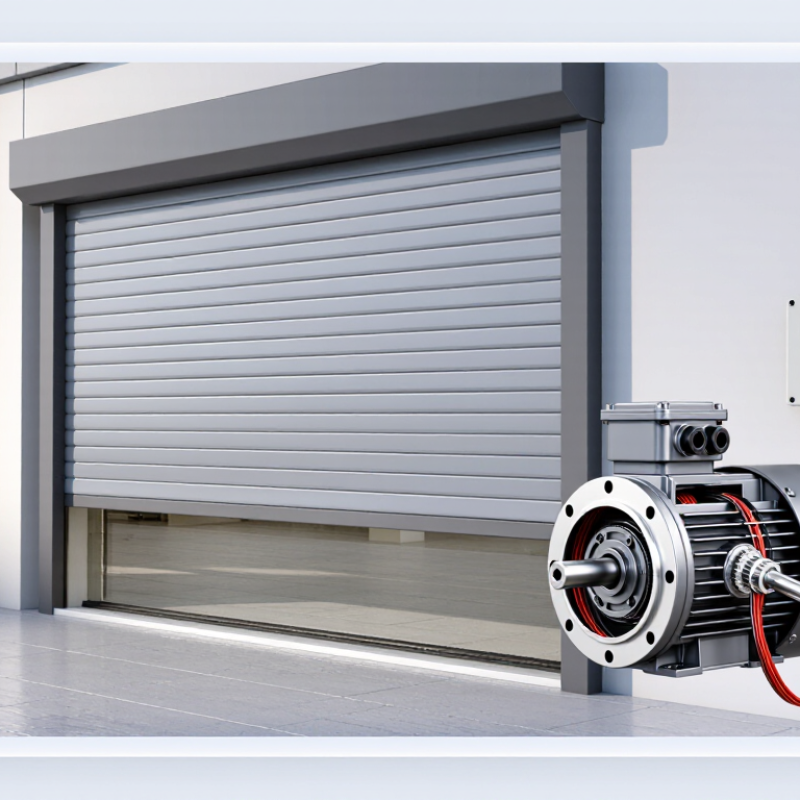
Start with the curtain, not the motor label. Measure its actual weight, width, height, and slat material. A 20-kilogram curtain creates about 19.6 newtons of force under gravity. With a 100-millimeter tube radius, basic torque reaches nearly 2.0 newton-metres. Add a practical safety margin of 25–30% for friction, cold conditions, and imperfect alignment. This calculation is simple, but many failures begin with guessed curtain weight.
Tube diameter changes the required torque. A larger tube radius needs more torque, even when the curtain weight stays unchanged. Check the tube’s internal diameter, keyway, and motor compatibility.
For wide shutters, consider deflection and uneven loading across the curtain. Oversizing is not always safer; excessive force can damage end locks and guides. EN 13659 and IEC 60335-2-97 provide useful safety and performance references for powered shutter systems.
Operating position also matters. A ground-floor shutter may cycle several times daily, while a commercial opening may operate continuously. Choose the motor’s rated duty cycle accordingly. The U.S. Department of Energy reports that windows can represent roughly 25–30% of residential heating and cooling energy use, so reliable closure affects more than security.
My practical mistake was trusting rated lifting capacity without checking tube size. Measure twice. Then verify limits, emergency operation, and installation alignment before ordering.
How to Choose the Right Roller Shutter Motor?
Calculate Required Torque with T = Force × Tube Radius
Choosing a roller shutter motor starts with torque, not motor speed. Torque is the turning force needed to lift the curtain safely. Use the basic formula: T = F × r. Here, T means torque in newton-metres, F means lifting force in newtons, and r means the tube radius in metres.
Measure the shutter curtain instead of guessing its weight. A steel curtain may feel surprisingly heavy, especially with a wide opening. Convert its mass into force by multiplying kilograms by 9.81. For example, a 60-kilogram curtain produces about 589 newtons of force. If the effective tube radius is 0.08 metres, the calculated torque is about 47 Nm. That is the working requirement before considering resistance.
The radius can change as the curtain rolls onto the tube. This detail is easy to miss. Dirt, stiff guides, worn bearings, and uneven installation can also increase resistance. Add a sensible safety margin, often around 25% to 40%, according to the site conditions and manufacturer guidance. In this example, a motor rated near 60 Nm may be more practical than one rated exactly at 47 Nm. Do not rely only on the curtain’s labelled weight. Check manual movement, shaft condition, mounting alignment, and stopping performance. My calculation may still be imperfect. Real shutters rarely behave like clean laboratory equipment.
| Application | Shutter Width | Shutter Height | Estimated Curtain Mass | Effective Lifting Force | Tube Diameter | Tube Radius | Required Torque | Recommended Motor Torque* |
|---|---|---|---|---|---|---|---|---|
| Small residential window | 0.90 m | 1.20 m | 18 kg | 180 N | 70 mm | 0.035 m | 6.30 N·m | ≥ 7.88 N·m |
| Standard residential door | 1.20 m | 2.10 m | 26 kg | 260 N | 80 mm | 0.040 m | 10.40 N·m | ≥ 13.00 N·m |
| Wide residential opening | 2.40 m | 2.10 m | 42 kg | 420 N | 90 mm | 0.045 m | 18.90 N·m | ≥ 23.63 N·m |
| Insulated garage door | 2.70 m | 2.40 m | 61 kg | 600 N | 100 mm | 0.050 m | 30.00 N·m | ≥ 37.50 N·m |
| Heavy-duty shopfront shutter | 3.60 m | 3.00 m | 87 kg | 850 N | 120 mm | 0.060 m | 51.00 N·m | ≥ 63.75 N·m |
| Large commercial shutter | 4.80 m | 3.60 m | 122 kg | 1,200 N | 150 mm | 0.075 m | 90.00 N·m | ≥ 112.50 N·m |
| Calculation: Torque T = Force × Tube Radius. For example, a 600 N lifting force acting on a 0.050 m radius produces 600 × 0.050 = 30.00 N·m of required torque. The recommended motor torque applies a 25% reserve for friction, starting load, alignment variation, and normal operating margin. Final selection should be confirmed using the measured lifting force, shutter profile, mounting arrangement, and manufacturer specifications. | ||||||||
Choosing a roller shutter motor starts with torque, not appearance or rated speed. Measure the curtain weight, barrel radius, lifting height, and guide friction. A practical formula is torque equals lifting force multiplied by barrel radius, then divided by system efficiency. Add a 20–30% torque margin for friction, wear, cold conditions, and changing loads.
For example, an 80 Nm calculated requirement should lead to a motor rated between 96 and 104 Nm. Small details matter. Dust inside guides or a slightly distorted curtain can increase resistance more than expected.
The margin also supports longer service life. The International Energy Agency’s Energy Efficiency 2023 report states that electric motor systems use about 53% of global electricity.
This highlights why correct sizing matters for both reliability and energy use. An oversized motor may waste energy, increase impact forces, and complicate limit adjustment. An undersized motor may overheat during repeated cycles. The U.S. Department of Energy’s Industrial Decarbonization Roadmap also identifies motor-driven systems as major industrial electricity users.
In field checks, I have found that a clean theoretical calculation can still miss real guide friction. That is the weak point. Test the shutter under its heaviest practical condition, then verify current draw, stopping behavior, and duty cycle. A 20% margin may suit a clean indoor shutter, while an exposed installation may need closer to 30%.
How to Choose the Right Roller Shutter Motor?
Motor selection should begin with four operating facts: speed, duty cycle, voltage, and daily frequency. A fast motor can open a shutter quickly, but excessive speed may increase noise and impact at the end stops. Measure the curtain height, shaft diameter, shutter weight, and required opening time. Then compare the motor’s rated torque with the real load, not an optimistic estimate. The International Energy Agency estimates that electric motor systems consume about 45% of global electricity. Even a small mismatch can therefore create avoidable energy loss over years of operation.
Duty cycle describes how long the motor can run before cooling. IEC 60034-1 classifies service patterns, including continuous and intermittent operation. A residential shutter might perform four cycles daily, while a shop entrance may exceed 30 cycles. That difference changes the correct motor size. Check the manufacturer’s rated cycles per hour and thermal protection. Voltage must match the building supply, such as 120 V, 230 V, or a low-voltage control system. Frequency also matters: a 50 Hz motor is not automatically suitable for a 60 Hz supply. The U.S. Department of Energy’s motor-systems assessments consistently identify correct sizing and controls as major efficiency opportunities. Still, calculations alone are imperfect. Dust, cold weather, weak brackets, and uneven curtains can raise resistance. Leave practical margin, but avoid choosing the largest motor by habit. It may consume more energy and conceal installation problems.
Match motor speed, duty cycle, voltage, and daily operating frequency
These non-brand-specific reference profiles show how motor requirements typically increase from residential to industrial use. Lower speeds are generally suited to smaller shutters, while higher speeds and duty cycles support larger or more frequently operated shutters. Common nominal supply options include 120/230 V single-phase and 400 V three-phase systems; always match the motor voltage to the available site supply and verify the manufacturer's rated duty cycle.
Choosing a roller shutter motor starts with its environment, not its advertised lifting force. IP44 protects against solid objects above 1 mm and splashing water. IP55 adds dust protection and resistance to water jets, but neither rating permits immersion. Check the test conditions in IEC 60529, especially for damp garages, coastal air, or exposed façades. The International Energy Agency reports that buildings consume about 30% of global final energy, so dependable shading controls can support practical energy management.
Limit controls need careful attention. Electronic or mechanical limits should stop the curtain cleanly at both ends, without crushing the bottom rail. Manual override is valuable during power cuts, but it must remain reachable and clearly explained. EN 60335-2-97 addresses safety requirements for drives used with shutters, blinds, and similar products. Ask for a valid declaration and installation instructions, not only a logo on a sales sheet. The European Commission’s 2023 Safety Gate report recorded 3,412 product alerts, showing why traceable safety evidence matters.
Some specifications look reassuring. They are not enough. In field checks, installers should inspect cable glands, limit response, noise, and emergency operation after installation. A motor rated IP55 may perform poorly if its connector faces upward. I would also question lifetime claims without cycle-test conditions. The right choice is the motor that matches the opening, exposure, control method, and documented compliance.
Calculate required torque first. Torque is the turning force needed to lift the curtain safely. Motor speed comes later.
Use T = F × r. T is torque in newton-metres. F is lifting force in newtons. r is tube radius in metres.
Multiply the curtain’s mass by 9.81. A 60-kilogram curtain creates about 589 newtons of force. Weight labels may not always reflect real resistance.
A 60-kilogram curtain produces about 589 newtons. With a 0.08-metre tube radius, torque is about 47 Nm. This excludes friction and installation resistance.
The curtain changes the effective radius while rolling onto the tube. This can alter the lifting requirement. The detail is easy to overlook.
Add a practical margin for friction, wear, cold conditions, and load changes. A common starting range is 20% to 30%. Exposed or poorly aligned shutters may need more assessment.
Dusty guides, stiff side channels, worn bearings, and uneven mounting can increase resistance. A slightly distorted curtain may also drag. Small faults matter.
An undersized motor may overheat during repeated cycles. An oversized motor may waste energy and create stronger impact forces. Neither choice is ideal.
Move the shutter manually first. Check the shaft, guides, alignment, stopping action, current draw, and duty cycle. Test the heaviest practical condition. My calculation may still be imperfect.
Choosing the right roller shutter motor starts with understanding the shutter itself. Consider the curtain’s weight and dimensions, the tube diameter, and whether the motor will operate from the side or inside the tube. If you are asking, “what is a roller shutter motor,” it is an electrically powered device that raises and lowers a shutter while controlling movement safely and efficiently. To select the correct model, calculate the required torque using T = Force × Tube Radius, then add a 20–30% allowance to handle friction, normal wear, and changes in load.
Motor speed should suit the shutter’s size and desired opening time, while the duty cycle and expected daily operating frequency must match the application. Also check the available voltage and confirm that the motor provides suitable protection, such as IP44 to IP55, depending on the installation environment. Limit controls, a manual override, and compliance with EN 60335-2-97 are important for reliable and safe operation.

Torsion Motor